

THE HUMAN EDGE OF AI TRANSFORMATION
AUTHENTIC
INTELLIGENCE™
AI ACTIVATION
POWERED BY YOU

This isn’t about ‘AI adoption.’
It’s about activating human brilliance, and confident impact.
Authentic Intelligence™ restores team member agency inside an AI-shaped world.
So authority, and accountability stays human.
And, AI amplifies what matters.

Most organizations are already "doing AI"
Licenses are rolled out.
Pilots show promise.
Training boxes ticked.
Then usage plateaus instead of compounding….
Not because the technology underperforms.
But because responsibility for making AI matter is often not placed where work actually happens.
AI gets introduced everywhere, but owned nowhere.
Everyone is involved.
No one is accountable for meaning, direction, or application.
So momentum diffuses.
Energy dissipates.
And AI becomes another initiative instead of a force.
That is where transformation stales.
Authentic Intelligence™ addresses the missing layer in AI transformation:
The human signal that determines whether AI becomes background noise or a force multiplier.
MISTAKEs ORGANIZATIONS KEEP MAKING
WHERE AI TRANSFORMATION STRATEGY BREAKS DOWN
AI strategy rarely fails at intent.
It fails at translation.
The strategic narrative sounds right at the top, but it doesn’t survive contact with real work.
Between vision and execution, something critical gets lost: clarity about how AI actually changes what people do, decide, and prioritize.
So strategy remains conceptual, while work stays the same.
That gap is where momentum drains.
Not because people lack capability.
But because they are positioned as followers of a system instead of the shaping force that gives it value.
What happens next isn’t theoretical.
It shows up consistently in the data.
When AI transformation strategy never translates into lived work, the pattern is predictable: early momentum, followed by confusion, hesitation, and halts.
That’s why the same outcomes appear again and again, across industries, roles, and geographies.
Research sourced 2024-2025: Accenture, AI Accelerator Institute, AICerts News, AvecGlobal, BCG (Boston Consulting Group), Deloitte, EY (Ernst & Young), Forbes, Gallup, Gartner, Gloat, Harvad Business, Harvard Business Review (HBR), IBM, Integrate, KPMG, KnowledgeRidge, Lighthouse Global, LinkedIn, McKinsey & Company, Microsoft, MIT, MIT Sloan Management Review, OCM Solution, Prosci, PwC, SEO, Tech Council of Australia, TriNet, TrueProject, UTS, World Economic Forum, YouGov/Zendesk.
THE SIGNAL OF INTERNAL COHERENCE
CUSTOMERS
Because all roads lead to them.
Customers experience AI transformation whether it’s intentional or not.
When AI is misaligned internally, customers feel it as:
Inconsistency
Friction
Diluted experiences
When people are clear, confident, and in command of how AI is leveraged, customers experience:
Speed
Relevance
Ease
Customer experience is the downstream signal of internal coherence.
AI can alienate customers if it lacks a human touch, eroding trust and loyalty.
Customers are often uncomfortable with AI-only service and worry they’ll lose access to real human help.
64% of customers would prefer companies not use AI in customer service at all
53% said they would consider switching if a company relied heavily on AI for service
Empathy scores declined 4% globally as brands deployed AI without maintaining human connection
ENTERPRISE ENTHUSIASM vs IMPACT GAP
ORGANIZATION
Top-tier business challenges.
Strategy says one thing.
Incentives say another.
Daily work and decisions say something else.
AI mirrors that fragmentation.
When direction isn’t coherent, AI amplifies confusion instead of advantage.
AI investment doesn’t fail because of ambition.
It fails because value is not clearly defined, owned, or measured.
74% of companies have yet to see tangible value from their AI investments
Only 39% report any bottom-line (EBIT) impact from AI
Just 5% of organizations realized measurable ROI from generative AI
$500 billion annual AI productivity gap in the U.S. due to lack of integration and training
60% of firms see little measurable benefit from AI programs
Organizations using AI for decision-making are 23% more likely to outperform competitors
AI-driven workflow redesign delivers 15–30% returns over five years
30% improvement in operational efficiency expected when AI is combined with IoT + 5G
AI doesn’t fail at innovation. It fails at continuation.
Most organizations can start pilots. Very few can turn them into repeatable, enterprise value.
74% remain stuck in proofs-of-concept
70% of AI initiatives stall at pilot stage
Only 30% of AI pilots ever reach enterprise-wide deployment
65% of executives say their organization has too many disconnected AI experiments
67% of organizations report reinventing similar AI use cases across teams
22% of organizations have a repeatable AI scaling model
80% of AI projects fail, twice the rate of traditional IT initiatives
~ 90% of enterprises use AI in at least one function
2/3 stay stuck in the experimentation or piloting stage instead of scaling
88% get stuck at pilot and never reach production
26% develop the capabilities to go beyond pilots and generate significant returns
72% get locked in pilot mode for tools like Microsoft 365 Copilot; only 6% have completed a global deployment
When authority is unclear, progress freezes.
AI stalls when no one knows who decides, who owns outcomes, or who carries the risk.
71% of enterprises cite security, privacy, and governance issues as the top barrier to scaling
47% of IT leaders have little or no confidence managing AI security and access risks
58% of AI programs are abandoned within 18 months due to lack of ownership and clarity
61% of executives say decision rights around AI are unclear
56% of organizations lack clear human-in-the-loop standards
68% of firms cite risk ambiguity as a blocker to AI scale
72% of organizations rely on informal judgment rather than defined AI governance models
21% of enterprises have clear accountability for AI outcomes
LEADERSHIP BROADCAST
LEADERS
Many leaders assume momentum follows rollout.
In reality, it follows their confident role-modeling, and implementation direction.
When leaders fail to communicate clarity, and stay adjacent to AI instead of inside it, the signal is clear:
“This matters, but not enough to change how I work.“
Teams read that message instantly.
Vision without translation becomes noise, and incongruence.
AI strategies fail when they never reach daily decisions, KPIs, or real work.
59% report a disconnect between AI vision and operational KPIs
67% of leaders say AI strategy is not clearly translated into day-to-day work
Only 27% of leaders can clearly link AI initiatives to specific performance outcomes
62% of executives say AI success metrics are too technical to guide behavior
Leaders are expected to move fast with tools they haven’t mastered.
AI exposes confidence gaps long before it delivers competitive advantage.
75% of leaders say they feel pressure to adopt AI faster than they understand it
70% of executives admit they are not confident explaining AI decisions to their teams
Only 15% of leaders feel highly confident leading AI-driven change
64% of leaders fear loss of credibility if AI initiatives fail
58% of leaders avoid AI decision ownership due to perceived personal risk
Only 22% of organization are beginning to scale leadership capabilities
TRADITIONAL CHANGE MODELS DON'T WORK IN AN AI ERA
CHANGE, TRANSFORMATION, AND WORKPLACE CULTURE
Most change efforts focus on explaining AI.
Very few redesign how people experience authority, relevance, and risk once it’s introduced.
Communication increases.
Confidence doesn’t.
Adoption lags where personal stakes are left unresolved.
Training people on tools does not change how work happens.
Adoption plateaus when AI is introduced without redefining roles, decisions, and value.
73% of employees say AI programs focus on tools, not how work actually changes
69% of organizations treat AI adoption as training, not transformation
Just 26% of AI change programs address mindset, confidence, and agency
66% of AI initiatives reuse legacy change models designed for prior technology waves
AI initiatives fail 2× more often when change is treated as communication-only
80% of AI projects fail, twice the rate of traditional IT initiatives
Only 4% have cutting-edge AI capabilities across the enterprise
63% identify human factors (fear, resistance, lack of alignment) as primary hurdles – not the technology itself
Human-level paradox emerging…
Employees who use AI are reporting productivity gains and higher anxiety simultaneously. BCG’s 2024 AI at Work survey found about half of employees using GenAI save ≥5 hours/week, indicating genuine efficiency boosts. Moreover, many employees say AI has improved innovation and even satisfaction in their jobs Yet, those same power users are more likely to fear AI will render their roles obsolete (49% of regular GenAI users worry their job may disappear, vs 24% of non-users).
Teams improvise when direction is missing.
AI use fragments when every team invents its own rules, tools, and standards.
68% of teams lack clarity on when to use AI vs human judgment
63% of managers say teams are experimenting without shared direction
29% of teams use common AI use-case standards
57% of managers report AI is used inconsistently across similar roles
38% of AI adoption challenges stem from insufficient training in AI tools
Teams with clear AI decision boundaries are 2.3× more likely to sustain usage beyond 90 days
Managers are the multiplier everyone forgets to train.
Without guidance, managers unintentionally stall AI momentum.
Mid-level managers are often the most resistant group, more so than executives or frontline team members
71% of managers feel unprepared to guide AI use in their teams
Only 24% of managers have received AI-specific leadership guidance
62% of managers default to “figure it out yourself” approaches for AI
Managers with AI playbooks drive 40% higher sustained adoption
VALUE DRIVERS NEED AGILE COMMUNICATION, CAPABILITY, AND COACHING
TEAM MEMBERS
For individuals, AI becomes powerful when it stops feeling like an extra layer and starts feeling like an extension.
People disengage at the intersection of:
A diluted what’s in it for me (WIIFM),
outputs they don’t trust,
and sudden drops in confidence.
Without clarity, effort slowly collapses.
Fear of loss, displacement, and devaluation
People don’t resist AI. They resist uncertainty about their role and future
Fear rises when AI is introduced without clarity or consultation
#1 barrier employees cite is not knowing how AI fits into their job – 44%
65% of employees worry AI will reduce their relevance at work
60% report fear of being evaluated or replaced by AI-driven metrics
Only 14% of workers have actually experienced job displacement; fear far exceeds reality
72% of workers say they were not consulted in AI-related changes to their role
Fear of opaque, unreliable, or unaccountable systems
People disengage when AI feels unchecked or unaccountable
Trust collapses when responsibility for outcomes is unclear
52% of workers fear AI in the workplace
Just 34% of employees trust leadership to use AI fairly and transparently
60% worry about ethical or compliance risks
58% fear loss of human oversight
57% are concerned about inaccuracy or hallucinations
Loss of authorship, self-efficacy, and professional identity
AI transformation is personal before it’s technical
People engage when they understand how AI strengthens their role, not replaces it
66% of employees feel AI adoption is happening to them, not with them
58% are unsure how AI fits into their personal value at work
Only 31% feel confident deciding what tasks to delegate to AI
Only 26% of employees feel highly confident using AI, while 63% of CEOs believe workforce is ready – a dangerous perception gap
Employees with role-based AI clarity are 3× more likely to use AI weekly
If AI doesn’t improve today’s work, it won’t survive tomorrow.
Training fails when it stays abstract instead of task-level and role-specific.
70% of AI training is forgotten within 30 days if not applied to real tasks
Only 28% of employees say AI training improved their actual workflow
AI-driven workflow redesign delivers 15–30% returns over 5 years
55% of workers say AI tools feel detached from real work priorities
Task-based AI enablement increases sustained use by 47%
PEOPLE DON’T RESIST AI ADOPTION
They resist being stripped of relevance, meaning, and agency in the name of ‘adoption.’
What looks like resistance is usually a rational response to being sidelined.
Positioned as users instead of authors.
Receivers instead of shaping outcomes.
Implementers instead of the source of value.
Resulting in quiet disengagement long before failure is visible.
The problem isn’t awareness.
Or effort.
Or even fear.
AI has been introduced into organizations without redefining where responsibility and direction now live.
And until that’s clear, every layer struggles to gain traction.
It only becomes valuable in the hands of the people who co-create with it.

Emotionally Intelligent Tech: Data meets depth.
Resonance Before Rollout: If it doesn’t land, it doesn’t last.
Authentic Intelligence™ changes the relationship between people and AI.
AI stops being something you experiment with on the side and starts becoming a co-creation engine inside real work.
Not a feature.
Not a rollout.
A multiplier for expertise, creativity, and momentum.
Authentic Intelligence™ makes that expansion natural.
AUTHENTIC VS ARTIFICIAL
Artificial intelligence optimizes for patterns.
Authentic intelligence preserves what’s true to you.
Understanding and embodying your authentic self gives you the freedom to live more openly, connect more deeply, and feel successful and fulfilled, both personally and professionally.
Authentic Intelligence™ organizes around your clarity and discernment, not system defaults.
AI does not set direction. It reflects it.
AUTHENTIC TRANSFORMATION
- Begins with what matters to the people doing the work, not how tools are meant to be used
- Keeps personal authority and boundaries intact, instead of outsourcing thinking to automation
- Prioritizes origination over conformity, so AI extends real capability rather than manipulating behavior
Authentic Intelligence™ doesn’t ask people to fit themselves to technology.
It asks technology to respond to who people are when they align their actions, values, and beliefs, and step into their fullest expression in work and life.
A future where intelligence isn’t artificial – it’s authentic. Where strategy is emotionally intelligent, tech is people-led and strengths-based, and organizations don’t just adopt AI… they leverage it to expand their people’s ingenuity
Aligned. Alive. Amplified.
AN AI TRANSFORMATION EVOLUTION
Direction · Ownership · Leverage · Momentum
Consulting designed for:
Curious minds. Brave moves. Measured wins.
Authentic Intelligence™ moves beyond “how to use Al” training to encoding your brilliance into how Al shows up for you; your thinking is the source code.
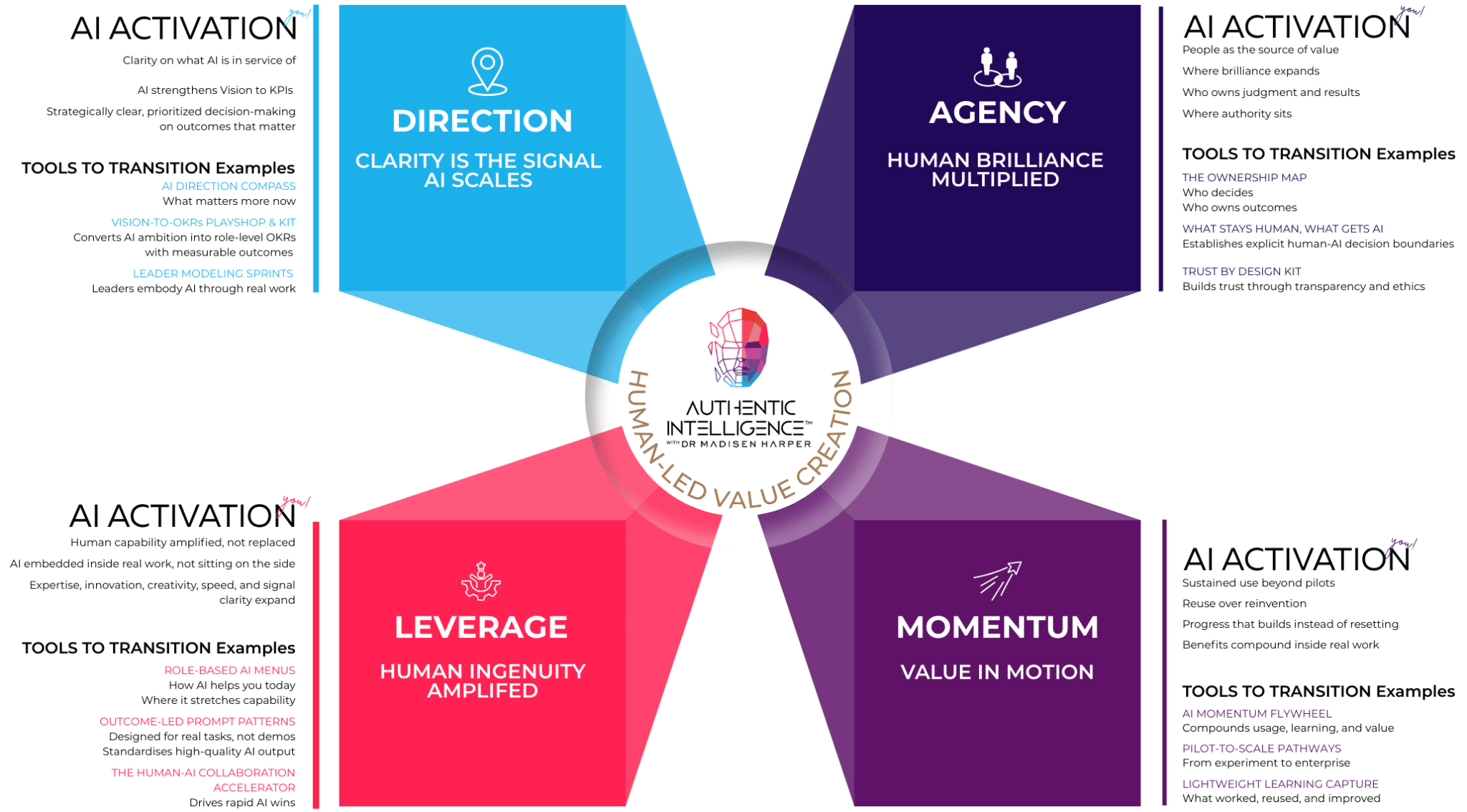
WHY AI NEEDS A DIFFERENT CHANGE LOGIC
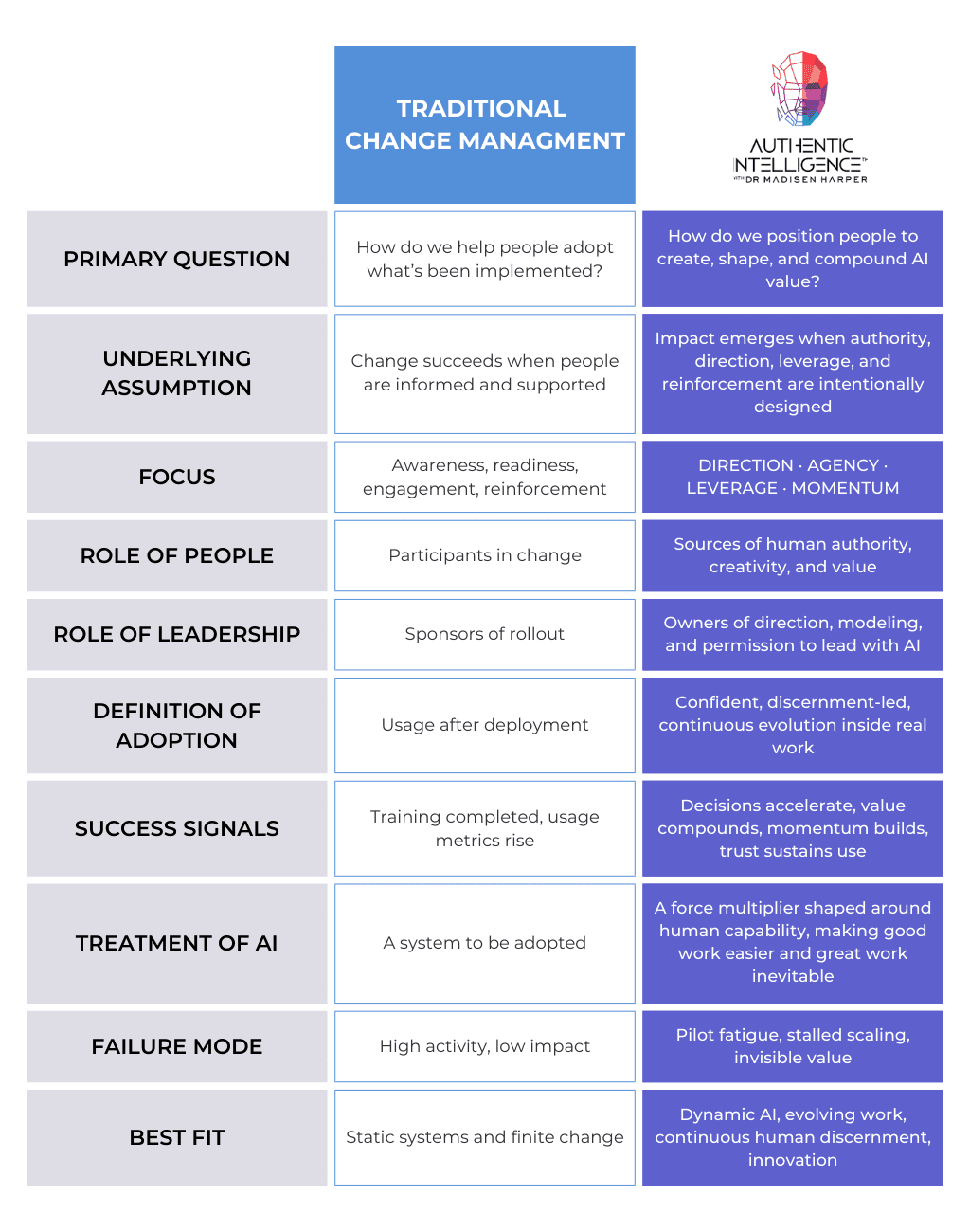
Traditional change management explains systems.
Authentic Intelligence™ is an advantage system that positions team members beyond technology ‘adoption’ to to architect their talent.
Human-Led, AI-Enabled, Authentically Aligned.
Your organization’s human edge in an AI world, where:
People use AI confidently, not cautiously
Teams build on each other’s momentum instead of starting over
Leaders see AI outcomes, not just activity
Customers feel the difference as speed, relevance, and ease
This is how AI transitions from being impressive
to being profitable.
Human-led value creation. Activated.
YOUR GUIDE

GRACIOUS DISRUPTOR
DR. MADISEN HARPER
Let's decode the complex human spirit together
Dr. Madisen Harper has invested over two decades working at the intersection of human behavior, leadership, and transformation.
She’s led and contributed to more than 100 digital transformation initiatives, working across industries, cultures, and scales, from early-stage disruption to enterprise-wide change.
Her work is grounded, intuitive, and practical. Less about forcing change, more about revealing what’s already there and reconnecting clients with their motivators, values, and desires.
Authentic Intelligence™ emerged from that work, not as a methodology, but as an AI era equivalent of seeing: people first, clarity always, value created from the inside out.
“AI transformation is the most exciting shift we’ve seen in decades, not because of the technology, but because it finally gives human brilliance leverage.”

YOUR GUIDE
GRACIOUS DISRUPTOR
DR. MADISEN HARPER
Let's decode the complex human spirit together
Dr. Madisen Harper has invested over two decades working at the intersection of human behavior, leadership, and transformation.
She’s led and contributed to more than 100 digital transformation initiatives, working across industries, cultures, and scales, from early-stage disruption to enterprise-wide change.
Her work is grounded, intuitive, and practical. Less about forcing change, more about revealing what’s already there and reconnecting clients with their motivators, values, and desires.
Authentic Intelligence™ emerged from that work, not as a methodology, but as an AI era equivalent of seeing: people first, clarity always, value created from the inside out.
“AI transformation is the most exciting shift we’ve seen in decades, not because of the technology, but because it finally gives human brilliance leverage.”
FAQs
WHAT IS ARTIFICIAL INTELLIGENCE (AI)?
Artificial intelligence (AI) refers to computer systems designed to perform tasks that typically require human intelligence, such as recognizing patterns, analyzing data, generating content, or making recommendations. In business and work contexts, AI functions as an intelligence layer that augments how people think, create, and solve problems rather than replacing human capability outright.
WHAT’S THE DIFFERENCE BETWEEN AI AND GENERATIVE AI?
AI is a broad category that includes systems designed to analyze, predict, and automate decisions. Generative AI is a specific type of AI that creates new content such as text, images, code, or data outputs based on patterns it has learned. In practice, generative AI becomes powerful when it is used to extend human expertise, not when it operates in isolation.
WHAT’S THE DIFFERENCE BETWEEN AI AND ROBOTS?
AI refers to intelligence, software, and decision-making systems. Robots are physical machines that may or may not use AI. Most AI used in organizations today has nothing to do with robots; it exists in software tools that support thinking, analysis, creativity, and work execution.
WILL AI TAKE MY JOB?
AI does not replace entire jobs. It changes how work is done. Roles that rely on critical thinking, creativity, leadership, and decision-making are amplified, while repetitive work is increasingly automated.
WILL ROBOTS TAKE MY JOB?
For most industries, robots are not the issue. The real shift comes from AI embedded in everyday tools. The question is not whether robots will take jobs, but whether people are supported to evolve how they work as AI becomes part of the environment.
WHAT IS AI TRANSFORMATION?
AI transformation is not the rollout of tools or technology. It is the shift in how people, teams, and organizations work once AI is introduced. Successful AI transformation shows up as better decisions, faster execution, clearer focus, and stronger outcomes, not just higher usage statistics.
WHAT ARE AI BUSINESS TRANSFORMATION CHALLENGES?
The biggest challenges in AI business transformation are rarely technical. They include unclear leadership signals, misaligned incentives, lack of confidence, fear of getting it wrong, and using old change models for a fundamentally new capability. When these issues are ignored, AI adoption stalls even after significant investment.
WHAT DOES AN AI TRANSFORMATION CONSULTANT DO?
An AI transformation consultant helps organizations make AI actually work in practice, not just in theory.
The role is not about choosing tools or running technical implementations.
It focuses on how AI changes the way people work, decide, and create value.
This includes:
clarifying where AI fits and where it doesn’t
helping leaders set the right tone and direction
supporting teams to use AI confidently and effectively
ensuring AI strengthens work, culture, and outcomes rather than adding confusion or friction
In short, an AI transformation consultant works at the human and organizational layer so AI investments translate into real impact, not hindered adoption or surface-level use.
WHAT IS AI ADOPTION?
AI adoption refers to how AI is actually used in daily work, not just whether it has been implemented. Traditional approaches measure adoption by logins, usage rates, or training completion. This approach looks instead at whether AI is influencing real work, improving outcomes, and being applied confidently where it matters.
WHAT ARE AI ADOPTION BARRIERS?
Common AI adoption barriers include low trust in outputs, unclear relevance to individual roles, fear of mistakes, lack of leadership modeling, and confusion about where AI fits into existing work. These barriers are human, not technical, and must be addressed directly for adoption to stick.
WHAT CAUSES AI ADOPTION FAILURE RATES?
AI adoption failure rates are driven by treating adoption as compliance instead of capability. When people are told to use AI without understanding how it supports their expertise or reduces risk, engagement drops. AI fails not because it doesn’t work, but because people don’t feel equipped to work with it.
HOW TO MEASURE AI ADOPTION?
Traditional metrics focus on activity. A more meaningful measure looks at outcomes: improved decision quality, reduced friction, increased confidence, faster execution, and visible impact on customer experience. Adoption is real when AI changes how work feels and flows, not just how often it’s accessed.
IS AI SECURE? DOES IT CAUSE CYBERATTACKS?
AI itself does not cause cyberattacks. Like any powerful technology, it can be used responsibly or misused. The real security risk comes from how AI is implemented, governed, and used by people, not from the technology alone.
When AI is introduced without clear boundaries, data safeguards, or user understanding, vulnerabilities increase. When it is implemented with strong security practices, clear policies, and informed use, AI can actually strengthen cybersecurity by detecting threats, identifying anomalies, and responding faster than humans alone.
Security is not an AI problem.
It’s an implementation and governance problem.
Done well, AI reduces risk.
Done carelessly, it exposes it.
WHAT ARE AI SECURITY PRACTICES?
WHAT IS AI COMPLIANCE?
WHAT IS AI GOVERNANCE?
AI security practices, compliance, and governance are the structures that ensure AI is used safely, responsibly, and appropriately inside an organization.
AI security practices focus on protecting data, systems, and access: things like data privacy, access controls, monitoring, and safe usage guidelines.
AI compliance ensures AI use meets legal, regulatory, and industry requirements, including privacy laws, employment regulations, and sector-specific standards.
AI governance defines who is responsible for AI decisions, how AI is approved, where it can be used, and how risks are managed over time.
Together, these are not about slowing innovation.
They exist to make AI trustworthy, sustainable, and scalable without creating unnecessary fear or bureaucracy.
CAN I TRUST AI? ESPECIALLY ITS OUTPUTS?
AI can be trusted to a point, but it should never replace human expertise.
AI is excellent at:
spotting patterns
summarizing information
generating options
accelerating thinking
But AI does not understand context the way people do, and it does not know when it is wrong unless a human does.
This is where subject-matter expertise remains the trump card.
Experts routinely review AI outputs and say,
“That sounds plausible, but that’s not how this actually works.”
And they’re right.
The most effective use of AI is collaboration, not delegation.
AI extends human intelligence, but people remain smarter, more contextual, and more accountable.
AI is powerful.
Human expertise is still decisive.
Trust AI to assist.
Trust people to decide.
HOW CAN AI TRANSFORM BUSINESS?
AI can transform business by accelerating insight, reducing friction, and expanding what teams are capable of creating. The transformation happens when AI supports strategic thinking, problem-solving, and innovation, rather than adding another layer of complexity or administration.
HOW IS AI TRANSFORMING THE WORKPLACE?
AI is reshaping the workplace by changing how tasks are performed, how decisions are made, and how value is created. The most successful workplaces treat AI as a collaborative capability that enhances human contribution, rather than a system people must adapt to under pressure.
HOW DOES AI TRANSFORM WORK?
AI transforms work by removing unnecessary effort, supporting faster thinking, and enabling people to operate at a higher level of contribution. When integrated well, AI becomes part of the natural flow of work rather than an interruption to it.
WHAT ARE THE NEGATIVE IMPACTS OF AI AT WORK?
The downsides of AI at work are rarely about the technology itself. They usually come from how AI is introduced and used.
Common downsides include:
Over-reliance on AI outputs, where people stop applying their own thinking or expertise
Loss of confidence, especially when people feel they’re expected to use AI without understanding it
Poor-quality decisions, when AI outputs are accepted without review or context
Increased stress or resistance, when AI is added on top of existing workloads instead of replacing low-value work
Security and privacy risks, if data is shared without clear guidelines or controls
These downsides are not inevitable. When AI is introduced thoughtfully, with clear boundaries and human oversight, it can reduce pressure, improve work quality, and expand capability instead of creating new problems.
HOW DOES AI TRANSFORM DATA?
AI transforms data by making it more accessible, interpretable, and actionable. Instead of data being something specialists analyze after the fact, AI allows insights to surface in real time, supporting better decisions across roles and functions.
HOW WILL AI TRANSFORM THE WORLD?
AI will transform the world unevenly. Organizations and individuals who integrate AI thoughtfully will move faster, adapt more easily, and create new value. Those who treat AI as a purely technical upgrade will struggle to realize its full impact.
HOW IS AI TRANSFORMING OUR LIVES?
AI is becoming embedded in everyday life through tools, services, and experiences that feel increasingly seamless. The most positive transformations occur when AI supports human autonomy, creativity, and choice, rather than replacing them.